
Playability is part of the signal path.
Setups, measured fretwork, refretting, nut and saddle work, intonation, electronics, pickups and recording preparation.
Fix the geometry, not the symptom.
The target is an instrument that plays cleanly, intonates predictably and responds the way the player expects. Relief, fret geometry, nut height, action, bridge position and intonation are treated as one connected system rather than a sequence of isolated adjustments.
Relief, action, bridge geometry and pickup balance adjusted around the instrument, the strings and the player.
Measured diagnosis of wear, buzz and unevenness, followed by leveling, crowning or refretting when the geometry actually requires it.
Slot height, break angle and string path corrected as part of the complete setup rather than treated as isolated details.
Strobe-referenced adjustment so chords and lines remain credible across the instrument’s real playing range.
Controls, wiring, grounding, noise, pickup installation, pickup balance and troubleshooting.
Remove avoidable mechanical and electrical problems before the session, when small faults become very audible.
Measure the neck under playing conditions.
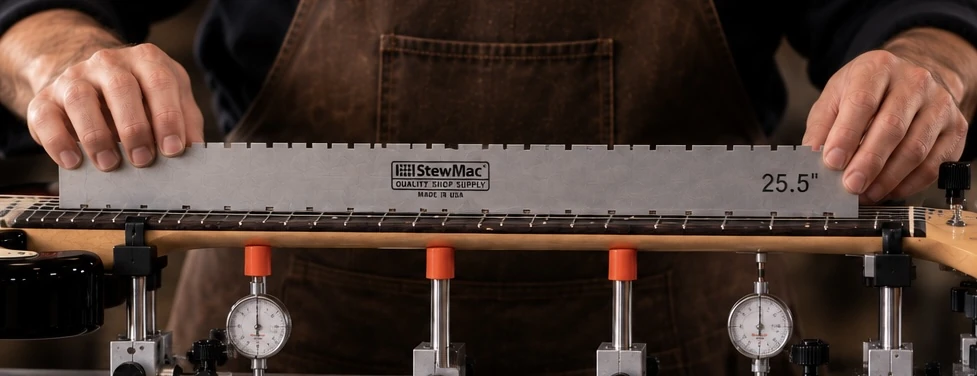
The StewMac Erlewine Neck Jig Workstation lets us record the neck’s geometry with the instrument strung and tuned, then reproduce that loaded condition after the strings are removed for fret or fingerboard work.
Three adjustable supports establish the neck position while two independent dial indicators track deflection. The workstation can also be positioned to account for gravity in a playing orientation. The result is a repeatable mechanical reference before material is removed.
The jig does not replace judgment. It makes neck movement visible, so a local fret problem is not confused with the behavior of the neck itself.
We measure. We don’t guess.
Mechanical geometry and pitch are checked with independent references. Neck behavior is measured on the jig; final intonation is verified with strobe tuning rather than a coarse display or an assumed setup recipe.
Loaded neck geometry, relief, action and fret relationships are checked before deciding what should be altered.
Conn strobe hardware and StrobeSoft provide high-resolution verification for intonation work.
The instrument is checked again as a playable system after the mechanical work is complete.